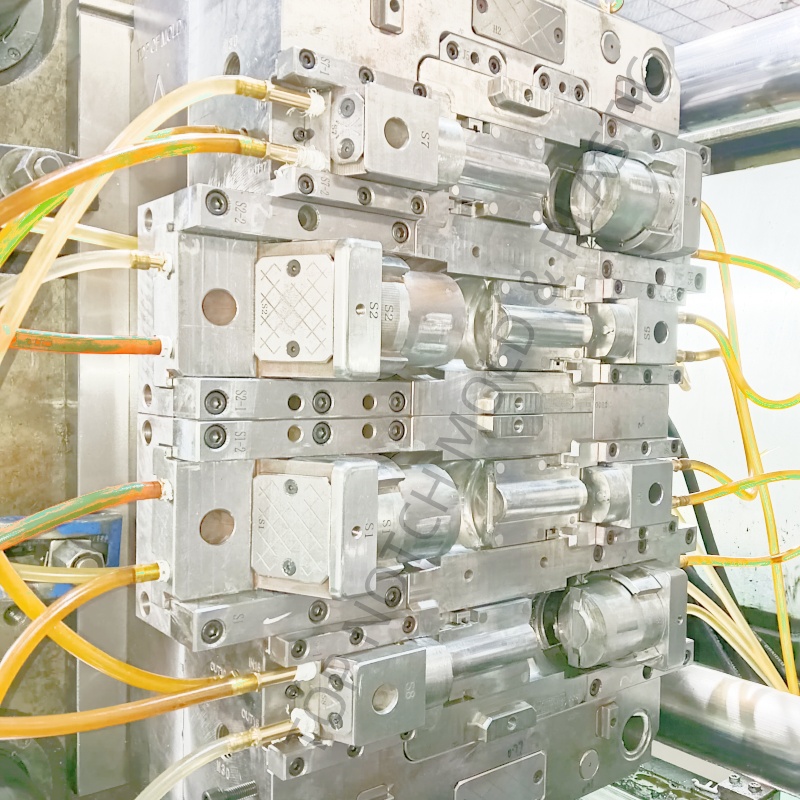
In the world of plastic manufacturing, injection molding is one of the most efficient and versatile methods to produce high-quality plastic parts. Among the various mold types, the multi-cavity injection mold stands out as a powerful tool for increasing productivity and achieving cost efficiency in high-volume production. Understanding its design, operation, and benefits is crucial for anyone in the plastic manufacturing industry.
A multi-cavity injection mold is a type of mold used in injection molding machines that allows multiple identical parts to be produced in a single injection cycle. Unlike a single-cavity mold, which produces only one part per cycle, a multi-cavity mold contains two or more cavities, each shaped to form the same part.
For example, if a mold has 8 cavities, the injection molding machine can produce 8 identical parts at once, significantly improving productivity. Multi-cavity molds are widely used in industries where high-volume production is required, such as automotive, electronics, packaging, and consumer products.
2. Structure of a Multi-Cavity Mold
A multi-cavity mold consists of several key components:
- Cavities: The hollow spaces in the mold that define the shape of the final parts. Each cavity is identical in size and geometry.
- Core: The counterpart of the cavity, which forms the internal features of the molded part.
- Runner System: Channels that guide molten plastic from the injection machine nozzle to each cavity. This can be a cold runner or hot runner system, depending on design requirements.
- Sprue and Gate: The entry point where molten plastic enters the runner system (sprue) and then enters each cavity (gate).
- Ejection System: Pins, sleeves, or plates that push the finished parts out of the mold after cooling.
- Cooling System: Internal channels that circulate water or oil to cool the mold efficiently, ensuring uniform part quality across all cavities.
3. Types of Multi-Cavity Molds
Multi-cavity molds vary depending on the number of cavities, the runner system, and the part layout:
- Symmetrical Layout: Cavities are evenly distributed around a central runner. Ensures uniform filling and balanced flow.
- Stacked Mold: Two or more layers of cavities stacked vertically, doubling production without increasing mold footprint.
- Hot Runner Mold: Uses heated channels to keep plastic molten until it reaches the cavity, reducing waste and improving cycle time.
- Family Mold: Contains cavities for different parts that are assembled together later. Technically multi-cavity, but for different components.
4. Advantages of Multi-Cavity Injection Molds
Multi-cavity molds offer several significant benefits:
a. Increased Productivity
The most obvious advantage is the ability to produce multiple parts in one cycle. For example, an 8-cavity mold producing a cycle every 30 seconds yields 960 parts per hour, compared to 120 parts per hour from a single-cavity mold.
b. Lower Unit Cost
Because the mold produces more parts per cycle, the cost per part decreases, even though the initial mold cost is higher. This makes multi-cavity molds ideal for high-volume production.
c. Consistency and Quality
Parts produced in the same mold at the same time experience identical process conditions, improving dimensional consistency and overall quality.
d. Reduced Labor and Machine Time
With multiple parts produced per cycle, less operator intervention is needed, and machine time is more efficient.
5. Challenges and Considerations
Despite their advantages, multi-cavity molds present some challenges:
a. Higher Initial Cost
Designing and manufacturing a multi-cavity mold is significantly more expensive than a single-cavity mold. Costs increase with cavity number and complexity.
b. Balanced Flow Requirement
Ensuring that molten plastic reaches each cavity simultaneously and evenly is critical. Uneven flow can cause defects such as short shots, warping, or sink marks. Advanced flow simulation software is often used to optimize design.
c. Tooling Complexity
More cavities mean more intricate runner systems, ejection mechanisms, and cooling channels, increasing mold design complexity.
d. Longer Lead Time
Multi-cavity molds take longer to design and manufacture, which may delay production schedules.
e. Material Limitations
High-viscosity or abrasive materials may require special runner design or mold materials to ensure uniform filling and mold longevity.
6. Applications of Multi-Cavity Molds
Multi-cavity injection molds are widely used in industries where high volume and precision are critical:
- Automotive Parts: Small components like clips, fasteners, and interior trim parts.
- Consumer Electronics: Housings, buttons, and connectors produced in bulk.
- Packaging: Bottle caps, closures, and small containers.
- Medical Devices: Syringe components, test tube caps, and other disposable parts.
- Household Goods: Kitchenware, toys, and plastic tools.
7. Design and Manufacturing Considerations
To maximize efficiency and minimize defects, engineers must carefully design multi-cavity molds:
- Cavity balance: Ensuring uniform flow through each cavity.
- Cooling channels: Even cooling to reduce warpage and shrinkage differences.
- Material selection: Mold steel hardness, plastic type, and shrinkage characteristics.
- Ejection system: Must remove all parts simultaneously without damage.
- Maintenance: Multi-cavity molds require regular inspection and cleaning to maintain quality.
8. Conclusion
A multi-cavity injection mold is a cornerstone of high-volume plastic manufacturing. By producing multiple identical parts per cycle, it dramatically increases productivity, reduces unit costs, and ensures consistent quality. While the initial investment is higher and design more complex, the benefits in mass production, efficiency, and cost-effectiveness make multi-cavity molds indispensable in industries ranging from automotive to medical devices.
Successful implementation depends on careful mold design, flow analysis, and process optimization, ensuring that every cavity produces a perfect part consistently. For businesses aiming for large-scale production, multi-cavity injection molds are the most efficient and strategic choice.