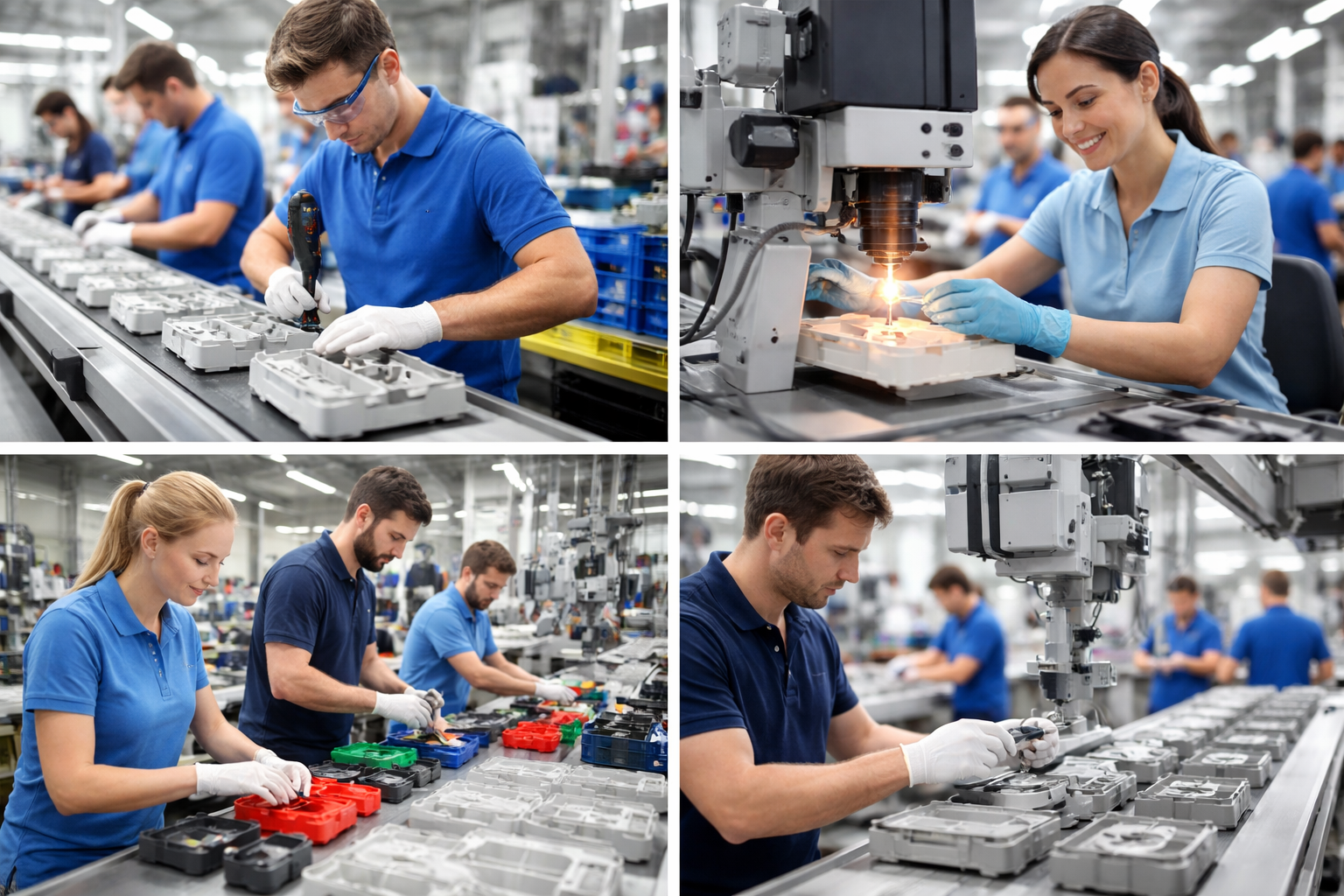
Assembly Process of Plastic Parts in the Injection Molding : Techniques, Methods, and Quality Assurance
Plastic injection molding is a cornerstone of modern manufacturing, producing high-precision parts for industries such as automotive, Elektronik, medical devices, consumer products, and industrial equipment. While injection molding allows the creation of complex, durable components, many finished products require assembly of multiple plastic parts or integration with other components, such as screws, electronic modules, or metal inserts. The assembly process ensures that parts function correctly, maintain quality, and are ready for the end-user. This article explores the assembly processes for plastic parts, including mechanical fastening, welding, adhesive bonding, and packaging, and highlights their importance in the injection molding business.
After plastic parts are molded, they are rarely ready to function as a complete product on their own. Many products require:
- Joining multiple plastic components.
- Combining plastic parts with metal inserts, fasteners, or electronic modules.
- Adding finishing touches, such as labels, logos, or protective films.
- Packaging parts into complete kits or products.
The assembly process involves a combination of manual and automated techniques, depending on the product type, production volume, and precision requirements. Proper assembly ensures product durability, safety, aesthetic quality, and customer satisfaction.
2. Mechanical Fastening (Screws, Clips, and Snap-Fits)
One of the most common methods of assembling plastic parts is mechanical fastening, including screws, clips, and snap-fit designs.
2.1 Screws and Bolts
- Screws provide a strong, detachable connection between plastic parts or between plastic and metal components.
- Self-tapping screws are often used in plastics, cutting threads directly into the part without pre-threading.
- Assembly considerations include proper pilot holes, thread design, torque control, and material selection to prevent cracking or deformation.
2.2 Snap-Fits
- Snap-fit connections are widely used in plastic assemblies because they are fast, cost-effective, and do not require additional hardware.
- Parts are designed with flexible tabs or hooks that “snap” into corresponding slots.
- Snap-fits require precise mold design and material selection to ensure proper elasticity and durability.
2.3 Clips and Rivets
- Clips or plastic rivets provide temporary or permanent connections.
- They are commonly used in automotive interiors, Unterhaltungselektronik, and household appliances.
Mechanical fastening offers advantages such as rework capability, ease of disassembly for maintenance, and strong, reliable joints. However, it may require additional labor or automation for installation, and design tolerances must accommodate the fastening method.
3. Plastic Welding Techniques
Plastic welding involves joining plastic components by melting surfaces together, forming a permanent bond without additional hardware. Common welding techniques include:
3.1 Ultrasonic Welding
- High-frequency ultrasonic vibrations create localized heat, melting the plastic at the joint.
- Widely used in medical devices, Elektronik, and automotive components for precision and speed.
- Requires careful design of weld features, horn contact areas, and joint thickness.
3.2 Hot Plate Welding
- Parts are pressed against a heated plate, melting the joint surfaces before being pressed together.
- Suitable for large or complex parts, such as housings or containers.
3.3 Spin Welding
- Parts are rotated against each other under pressure while friction generates heat at the interface.
- Ideal for circular or cylindrical components like caps, Container, or gear assemblies.
3.4 Laser Welding
- A focused laser beam melts the plastic joint to form a precise, clean, and invisible weld.
- Common in high-end consumer products, automotive sensors, and medical devices.
Plastic welding creates strong, permanent connections, is cost-effective for high-volume production, and eliminates the need for screws or adhesives in many cases.
4. Adhesive Bonding (Glue and Epoxy)
Adhesive bonding is another method for assembling injection-molded plastic parts. It is often used for joining dissimilar materials, enhancing sealing, or achieving invisible joints.
4.1 Types of Adhesives
- Solvent-Based Adhesives: Soften the surface of the plastic to bond components together.
- Epoxy and Two-Part Adhesives: Provide high strength and chemical resistance.
- Acrylic Adhesives: Fast-curing and suitable for plastics such as ABS, PC, and PMMA.
- UV-Curable Adhesives: Ideal for transparent parts and precise positioning.
4.2 Applications
- Bonding plastic to metal inserts or glass components.
- Creating water- or airtight seals in containers, medical devices, or automotive parts.
- Adding small decorative parts or labels that cannot be welded or snapped.
Adhesive bonding is versatile and can provide excellent strength and chemical resistance, but it requires curing time, proper surface preparation, and sometimes additional fixtures to hold parts during the process.
5. Inserts and Over-Molding in Assembly
Plastic parts are often combined with metal or electronic inserts during molding or as post-molding assembly steps:
5.1 Metal Inserts
- Threaded metal inserts allow screws to be used repeatedly without damaging plastic threads.
- Heat, ultrasonic, or press-fit insertion methods are commonly used.
5.2 Umspritzen
- Over-molding involves molding a second plastic layer over an existing part to combine materials, textures, or colors.
- It can integrate soft grips, seals, or protective layers directly into the part, reducing assembly steps.
6. Quality Control During Assembly
Quality assurance is critical in the assembly of injection-molded parts to ensure reliability, safety, and customer satisfaction. Typical quality control measures include:
- Dimensional Inspection: Verifying that parts fit correctly before and after assembly.
- Torque Testing: Ensuring screws are tightened to the correct specification without damaging plastic.
- Weld Integrity Testing: Ultrasonic, visual, or destructive testing for welded joints.
- Adhesion Testing: Ensuring glued or bonded parts meet strength and environmental standards.
- Functional Testing: Confirming moving parts operate as intended, and assembled products meet performance requirements.
Advanced assembly lines may integrate robotic automation, vision systems, and sensors to achieve high precision and repeatability.
7. Packaging and Final Assembly
Once assembly is complete, products are prepared for delivery:
- Cleaning: Removing dust, residue, or fingerprints from finished parts.
- Protective Coatings or Films: Prevent scratches during transport.
- Labeling and Barcoding: Adding product identifiers or serial numbers for traceability.
- Verpackung: Products are placed in boxes, trays, or protective wrapping, ready for shipment or distribution.
Efficient packaging is essential for maintaining product quality, protecting fragile or sensitive components, and meeting customer expectations.
8. Applications Across Industries
The assembly of injection-molded plastic parts is critical across many industries:
- Automotive: Dashboards, switches, panels, and sensor housings assembled with screws, welding, or adhesive.
- Unterhaltungselektronik: Phone cases, remotes, and household gadgets often require snap-fits, Schrauben, or glued assemblies.
- Medizinprodukte: Spritzen, diagnostic kits, and housings assembled with ultrasonic welding or adhesive bonding for sterility.
- Industrial Equipment: Protective housings, Getriebe, and mechanical assemblies requiring metal inserts and robust joints.
- Toys and Pet Products: Snap-fits, Schrauben, and glued parts ensure safety and durability.
9. Conclusion
The assembly process is a vital step in transforming injection-molded plastic parts into functional, reliable, and market-ready products. Techniques such as screws, snap-fits, welding, adhesive bonding, Umspritzen, and packaging ensure that parts meet durability, aesthetic, and functional standards. Proper quality control, process optimization, and careful selection of assembly methods enable manufacturers to produce high-volume, high-quality products efficiently.
In the competitive manufacturing landscape, an effective assembly process not only ensures product performance and safety but also enhances brand value, customer satisfaction, and market success. From automotive components to medical devices, Elektronik, and consumer goods, the assembly of injection-molded plastic parts remains a critical link in the chain of modern production.